

Designing Shopfronts
Time can be unkind to buildings, they are modified and changed as time and requirements dictate over the years. Listing a building stops further harm happening, but does not undo the wrongs of the past. Sometimes an opportunity to can arise however to do so.
The pair of buildings, one 17th century and one 19th century had been modified on the ground floor to provide a single unified frontage for a car dealership. When this closed, our clients looked to convert the building back to shops and we were tasked with designing a more appropriate pair of shopfronts, more suited to the individual buildings.
Designing for Beauty and Elegance
When we design homes we are always striving for beauty and elegance whilst maximising value area. Including accommodation floorspace within the roof structure can provide useful additional area, but can make the roof look quite bulky. To avoid the roof looking bulky, we often introduce dormers, rooflights and sprocketed eaves.
Introducing a sprocketed eaves can help to disguise the mass of the roof and provide a deep eaves to cast a pleasing shadow on the façade of the building. This award winning home in Wiltshire includes three storeys of accommodation but the gentle change of roof pitch (the sprocket) as it runs up helps visually lighten the mass this extra floor would normally create.

The Golden Ratio
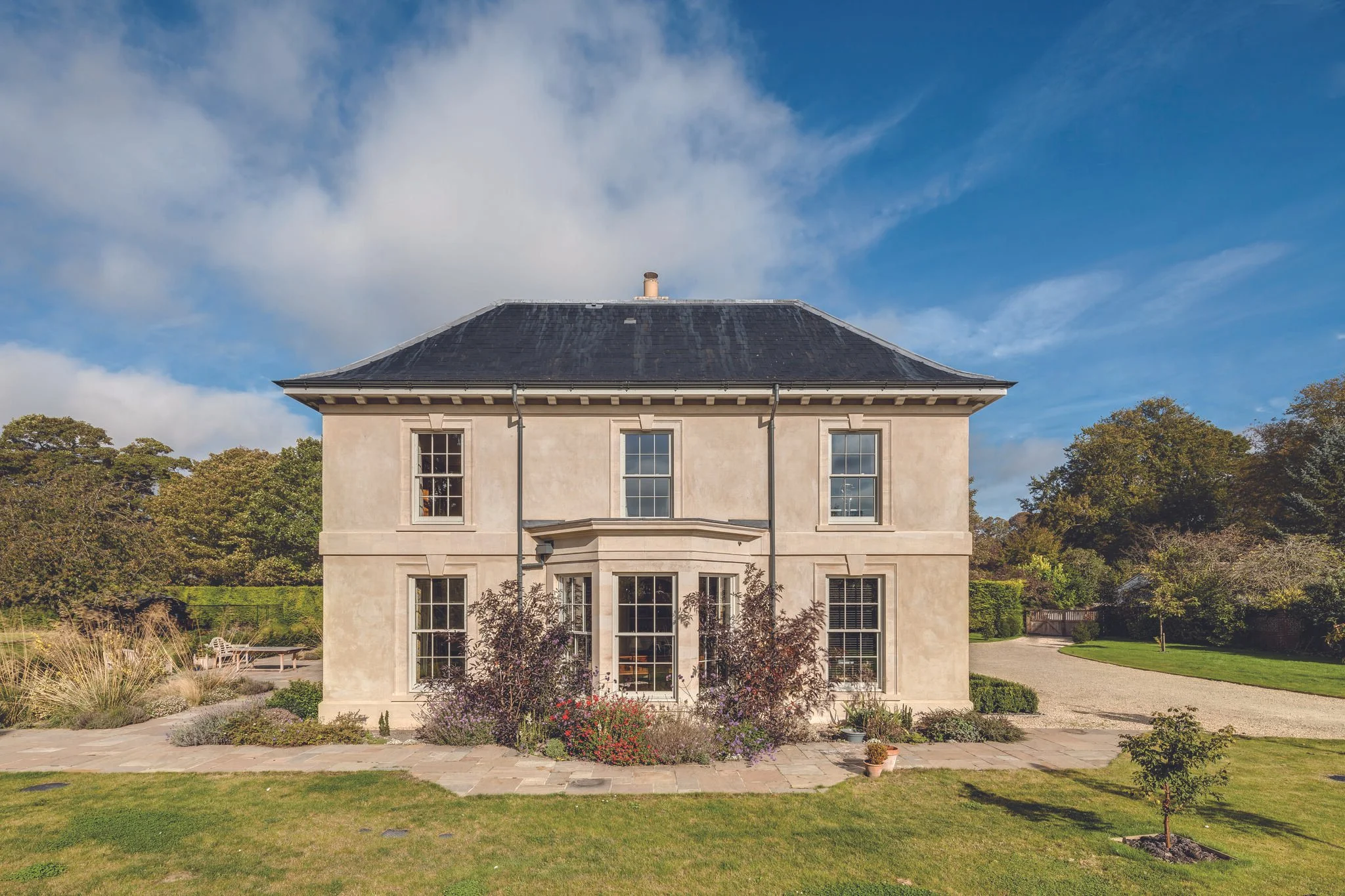
A ratio of 1:1.6180339887 doesn’t sound very glamorous, but this ratio, better known at the Golden Ratio, or the Divine Proportion underpins Classical architecture.
We take this principle very seriously and it underpins our work in the New Classical genre. This new house we designed in Hampshire has elevations carefully designed to Gold Ratio proportions. The result is a truly aesthetically pleasing family home which is a much admired part of our portfolio.

Unusual Discoveries in Conservation
We are lucky to see some very unusual buildings in the course of our conservation work.
You wouldn’t normally expect to find an industrial chimney in the back garden of a mid-1800s country house, but our research discovered an interesting story as to why. The settlement where the house is, was a built for the workers of a lumber mill which was originally steam powered. After three catastrophic fires as a result of embers catching sawdust alight, the chimney was moved further from the engines and into the garden of the mill owner’s house where it remains to this day, now under our watchful eye.

Working with Historic Buildings
Sometimes working with historic buildings is a puzzle, rarely though is the building itself literally a jigsaw puzzle.
An orangery had stood at this property in the West Country since the Victorian times, however a failed restoration in the 1960s saw the domed timber and glass structure collapse during heavy rain in the mid 1990s. We undertook a feasibility study for a potential purchaser to reinstate the collapsed building using the salvaged timbers.

Considering the Environmental Impact of Buildings
Just because a home looks traditional, doesn’t mean it can’t be environmentally friendly. The need to consider the impact of buildings on the environment becomes ever more pressing with each passing day
We’re committed to reducing the impact of schemes using a variety of approaches. Like this country house in Wiltshire where a vaulted gallery space on the first floor has the double function of filtering light onto the items within, but also providing passive stack ventilation.

Extending a Listed Building
There are different approaches that can be taken when extending a listed building. Alterations can be designed to contrast the historic building or to complement the existing fabric. Careful judgement is required to develop the right strategy for the building and the client.
For this Grade II* listed property in Hampshire, the right solution was to compliment, whilst remaining subservient to the original Queen Anne house.

A Georgian Style Property in the Test Valley
People often assume windows must be white, but that isn’t the case. There are many historical precedents for windows being coloured, throughout the history of architecture.
This Georgian style property we designed in the Test Valley has its windows, door case and porch painted in a pastel colour. This keeps the joinery feeling light and bright but without the starkness that brilliant white can sometimes bring.

Symmetry and Balance
A lot of the pleasure of traditional architecture is the aesthetic pleasure that symmetry and balance of the elevations can bring to the eye. Where buildings are joined to others as part of the same composition, differing ownerships and approaches to maintenance can lead to this balance being upset.
The careful restoration of our Grade II* listed Georgian town house project brought harmony and symmetry back to the building by treating the elevation as a whole piece rather than two separate halves. Elegance is restored.
From an Understated Bungalow to a Classical Country House
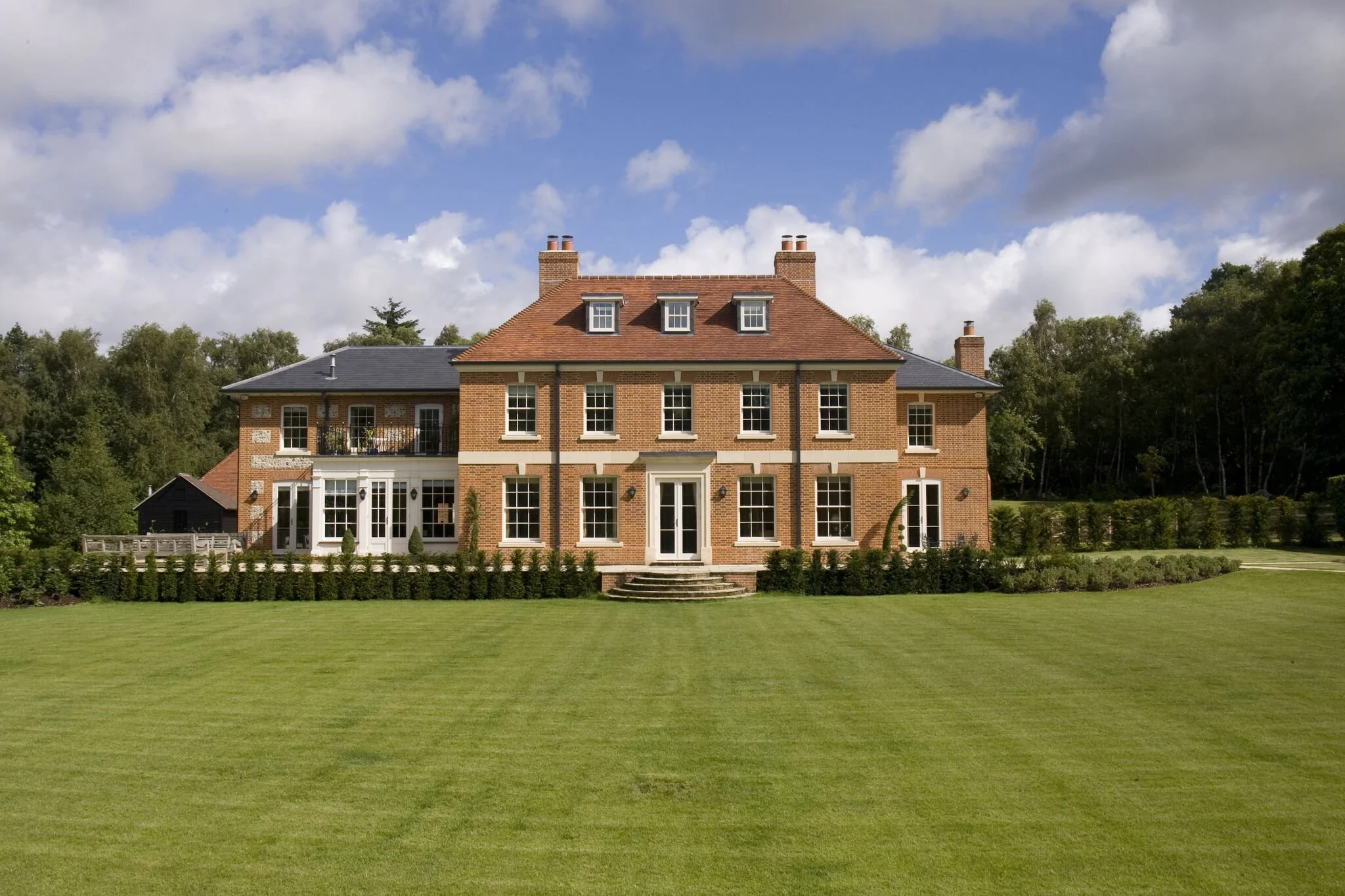
Seeing the potential in sites can sometimes be difficult, an underwhelming house in the wrong place on the plot can cloud someone’s judgement. We relish the challenge of looking beyond the existing to create a dream property whilst is perfect for the site.
A good example of that is this project in Berkshire we designed which replaced an understated bungalow with a Classical country house. The resulting house is much more suited to the parkland like gardens and sylvan setting of the property.

A Drawing Room of a Grade Listed Georgian House
The drawing room of this Grade II listed Georgian house we have been working on the restoration of in Wiltshire is a very comfortable room. But the glow from the open grate makes it feel even cosier. The relaxed ambiance this creates is something we strive for in our work, a home that puts you at ease in comfortable and reassuring surroundings.

A Lattice Porch for a Regency Style Home
Elegance doesn’t have to mean grandeur.
We strongly believe that buildings can be elegant without having to be ostentatious. A home which looks relaxed will help the family living in it, feel relaxed. An example of how we employ this idea is this metal lattice porch on the front of a new build Regency style home we designed in Wiltshire. The entrance to this classic three bay form is clear and in keeping, without being overtly grand, making the whole building look more comfortable on the village lane on which it sits.

Retaining Character on a Barn Conversion
We really enjoy working on barn conversions.
Giving an historic building, now defunct, a new lease of life is a very fulfilling project. The key is not to lose the character. Here is a before and after image of a Grade II Listed barn we converted in Hampshire. The intention was to retain as much of the historic fabric and character of the barn as possible whilst converting the barn into usable residential space. Constructed by the talented team at Moulding The Builder, we think we were successful in retaining the essence of the original building whilst at the same time reinstating lost features such as the double height threshing door openings.
Design and Location
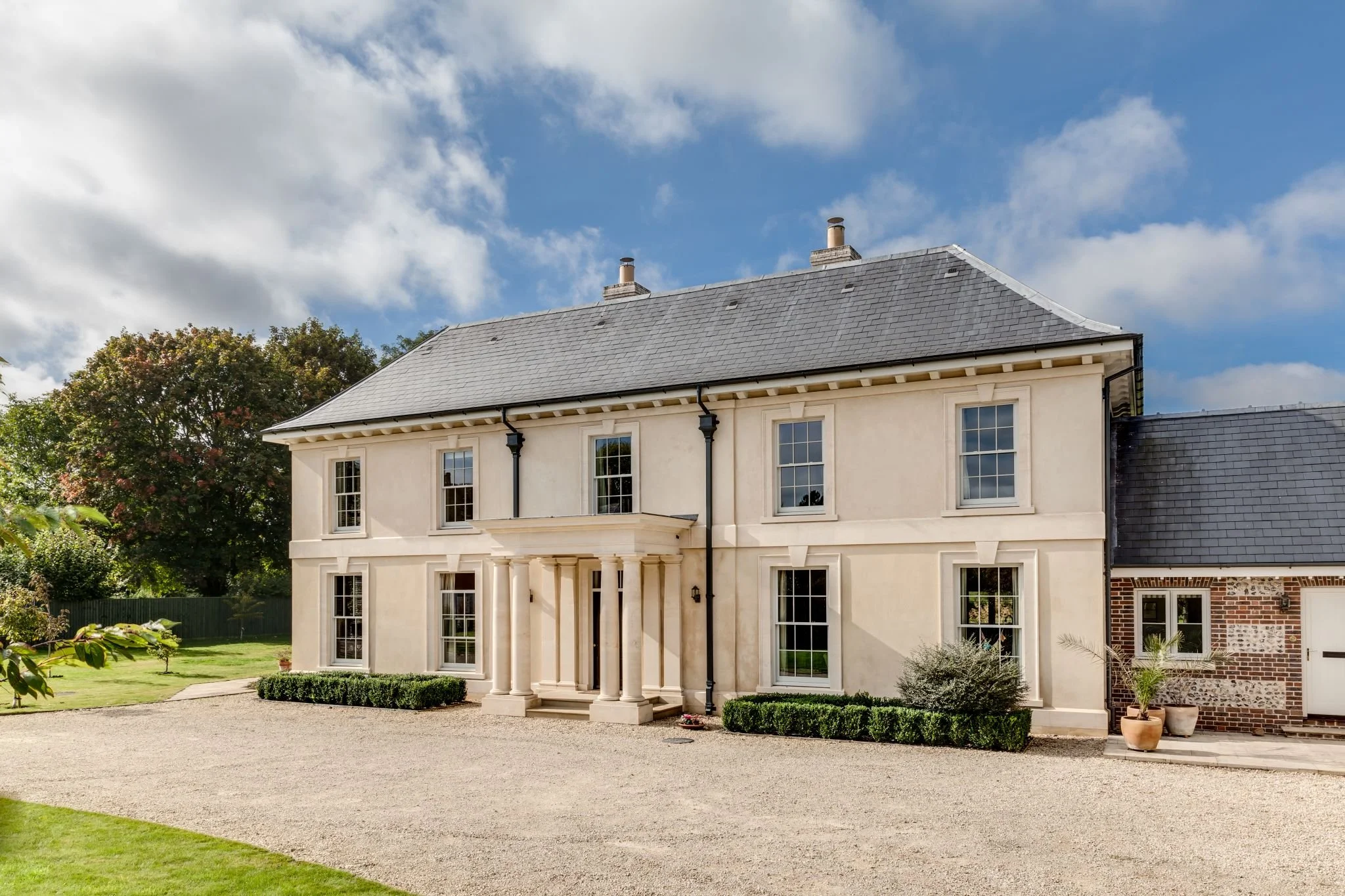
Context is key to a building feeling grounded in its location.
Although inspired by its surroundings, this award winning family home in Wiltshire does not borrow directly from its delightful Georgian neighbours. The design is instead the result of of the application of general principles of Georgian architecture. The outcome is a relaxed and pared-back design which is both comfortable as a modern family home should be, but with the elegance that comes with Classical architecture.

Introducing Renewable Technologies
It's good to be green, but being green shouldn't just be the preserve of new buildings, to really get on top of the problem, every building needs to be looked at carefully to see what can be done. If everybody does something, we'll be able to make a big difference. Even listed buildings can play their part.
We've recently gained planning and listed building consent for a program of restoration and upgrade works on a historic country estate in West Sussex. We have been working closely with Martin Thomas Associates M+E consultants, and a key part of the strategy worked out with them, is to introduce renewable technologies for the site. Here are some illustrations of the strategies to be utilised.

A New Country House in Hampshire
Sometimes the success of the new hinges on the past. We incorporate character into our new buildings by using materials specific to the local area, this allows them to sit more comfortably within their surroundings. In this case we used Chilmark stone from Lovell Stone Group, Michelmersh Brick Holdings PLC bricks and local flint.
This new country house in Hampshire was designed to appear as though it had evolved over time. The rear section was designed and details as a vernacular farmhouse, with the front section having a more formal Classical character, reflecting the evolution of many historic farmhouses, where their owners became more affluent and wished to enhance and gentrify their homes.

An Elegant Staircase Design
Another country house, another elegant staircase design.
For this project we designed this beautiful staircase which showcases traditional detailing at its best. The traditional wreathed volute at the end of the oak handrail compliments the single curtail of the bottom step and juxtaposes these traditional Georgian details with more contemporary metal spindles.

The Portico of an Elegant Grade II* Listed Town House
First impressions count. First impressions for a home, really count.
The portico of this elegant Grade II* listed town house was in need of some real tender loving care before we started our restoration project. The restored timberwork provides the sort of entrance you would expect and really sets the tone for the beautifully restored interior within.

The Importance of Proportion
We are passionate about proportion. Get it right and the elegance it creates is a given, you accept that things look right. Get it wrong and the fact something is amiss is obvious. The Golden Section (or Ratio) is a proportion system we often apply, using the mathematics of nature as described in the Fibonacci sequence, seen throughout nature and in Classical architecture. We used the Golden Section to get the proportions just so for this house in Wiltshire, and we were pleased when it won Best Traditional House in the Daily Telegraph Homebuilding and Renovating Awards The Telegraph.

A Historic Barn Conversion in Wiltshire
Even working on historic buildings, sometimes we get a chance to do something really striking, and we love to seize those opportunities!
This historic barn conversion in Wiltshire had views to the South over an Area of Outstanding Natural Beauty and we were able to secure consent for this feature dormer window. Not only did it allow views out, but it also allowed the previously uninhabited roofspace to be flooded with light, transforming the space from dingy loft to a light flooded and airy space.