
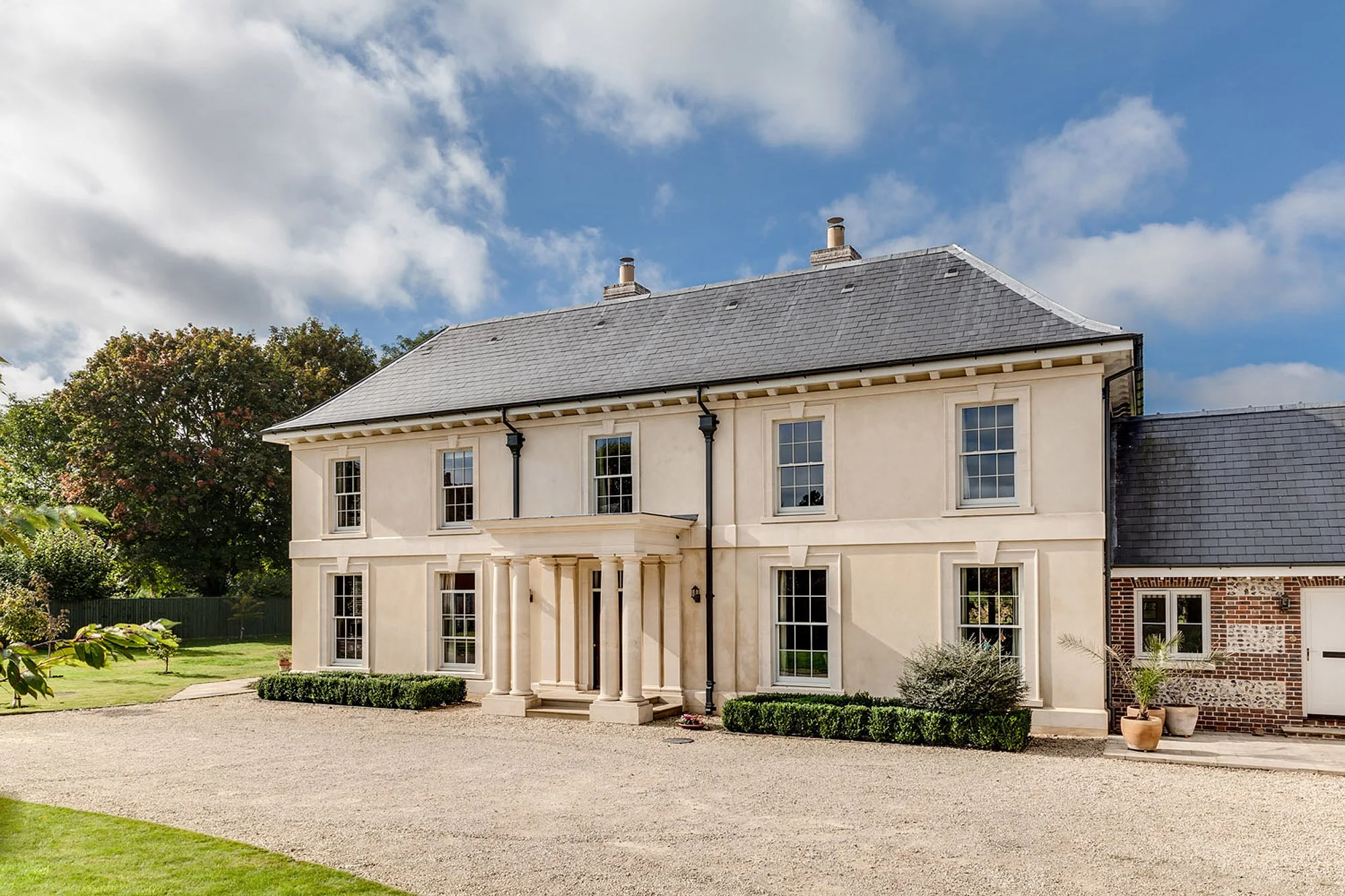
Learning from Georgian Architecture
Georgian architecture continues to influence the design of homes throughout Britain—and for good reason.
Its enduring appeal lies not simply in ornament or decoration, but in the disciplined use of proportion, symmetry and restraint. Georgian buildings are often characterised by carefully ordered façades, generous ceiling heights, balanced room arrangements and an abundance of natural light.
Many of the qualities people seek in homes today—comfort, elegance, flexibility and a strong relationship between rooms—can be found in the best Georgian buildings. Clear plans create a natural hierarchy between formal and informal spaces, while well-proportioned windows bring light deep into the interior.
At Alex Oliver Associates, we often look to Georgian architecture for inspiration. This does not mean simply replicating the past. It means understanding the principles that give these buildings their balance, clarity and enduring character, and applying them thoughtfully to contemporary life.
This approach informed our design for Bridge House in Avebury. Rather than directly copying its Georgian neighbours, the house draws upon their underlying principles of proportion, symmetry and hierarchy. The result is a restrained classical home with generous ceiling heights, large windows and flexible family spaces, designed to sit comfortably within its exceptionally sensitive historic setting.
Good architecture is often timeless because it is founded on principles that continue to work generation after generation.

A Traditional Farmhouse in Wiltshire
Situated within the North Wessex Downs AONB, this replacement dwelling reinterprets the Georgian country house with a more understated, relaxed character.
Classical proportions are combined with informal, light-filled spaces to create a home that balances the charm of farmhouse living with timeless elegance.
The result is a design that brings together order, comfort and flexibility, tailored to modern country life.

The English Country House
The English country house is a symbol of timeless elegance, and we take great pride in continuing this tradition through thoughtful, well-proportioned designs that respect historic character while meeting the needs of modern family life.
Our work at this house in the South Downs is a considered interpretation of the style, combining classical proportions with modern comforts and discreet technologies to support sustainable family living.

Timber Sash Windows
Timber sash windows are a defining feature of Britain’s architectural history, from elegant Georgian townhouses to Victorian terraces.
At Alex Oliver Associates, we prioritise high-quality, handcrafted timber sashes to maintain authenticity in restoration projects and traditional-style new builds.

A Traditional Country House in Wiltshire
This country house was built using a carefully considered combination of flint, brick, and stone to create character and visual appeal.
Flint, which has long been a staple of British vernacular architecture, remains a popular choice for the following reasons:
Naturally strong and weather-resistant—ideal for British climates
A low-carbon material, sourced directly from local quarries
Distinctive visual appeal, particularly in contrast with brick and stone

A New Georgian Country House
Classical architecture, for us, is not merely a style but a philosophy that embraces the values of balance, proportion, harmony, and order.
This new Georgian country house, situated within the North Wessex Downs AONB, reflects these principles, resulting in a home that is refined, timeless and responsive to its surroundings.

The Timeless Beauty of Natural Stone
Some of the most elegant homes are built from materials that stand the test of time.
Bath stone, sourced from a local quarry, was selected for this classical country house.
The natural stone brings warmth, texture and lasting quality to our design.

Timber Sash Windows
At Alex Oliver Associates, we use high-quality, handcrafted timber sash windows for our projects.
Why choose timber sash windows?
Period-accurate detailing for heritage properties
Sustainable & repairable—unlike uPVC alternatives
Beautiful proportions that enhance natural light

A New Regency Home in Wiltshire
This new Regency home in Wiltshire combines classical elegance with local vernacular charm to create a space that is versatile, welcoming, and highly appealing.
The front of the property is characterised by a formal, stucco-fronted façade that captures the grandeur and symmetry typical of Regency architecture. In contrast, the rear part of the house adopts a more vernacular style, blending seamlessly into the surrounding landscape and offering a charming, rustic counterpoint to the formal front. This approach creates a harmonious balance between the stately presence and elegant proportions of the Regency style and the cosy, approachable feel of vernacular architecture.

A Classical Country House in Surrey
Flint has been a staple of British vernacular architecture for centuries, particularly in the South of England. Whether used in traditional flint-knapped walls or as a striking feature in contemporary builds, this locally sourced, highly durable material adds character and texture.
This classical country house in Surrey demonstrates the distinctive visual appeal of flint, especially when paired with brick. The single-story flint wing creates an interesting contrast with the adjacent brickwork, enhancing the building’s character and appeal.


A Georgian Style Country House
This Georgian style country house was designed to have a formal character, reflecting the gentrification and rising affluence which led to the introduction of more formal and varied living accommodation to traditional farm holdings.

A Classical Entrance Portico
Widely used in Ancient Greece the idea of a portico on classical buildings has influenced many design cultures since.
The addition of a portico to this award winning house in Wiltshire adds depth and interest to what could otherwise be a ‘flat’ elevation. The signification of the entrance helps draw the eye visually and practically provides a covered place to stand while the door is opened. Simple, elegant and effective.

Proportion and Symmetry
At the heart of the classical language of architect are the ideas of proportion and symmetry. These drive the elegant looks of buildings designed in this language.
The benefits of the correct use of proportion and symmetry are illustrated nicely by this family home in Wiltshire. Careful balance is needed to create an elegant home and the successful result remains a popular project in our portfolio.

Sketch Visuals for an Infill Housing Scheme in Buckinghamshire
You don’t always need a huge amount of information to convey the sense of a space, place or set of buildings. Computer Generated Images have their place, but sometimes it is as much about what you leave out as much as you leave in.
These sketch visuals of an infill housing scheme in Buckinghamshire are not ultra realistic, but they still give the overall impression of the feeling of the development. A collection of traditionally styled houses give the feeling of a series of homes which have been part of the village, rather than new introductions.

A Feature in Country Life
We're pleased to see one of our houses featured in Country Life Property this week.
Penny Churchill spoke to Alex about this family home we designed in Berkshire, to discuss the design thinking behind it.
The property is now for sale through Alex Barton at Strutt & Parker in Newbury.

A Classical Villa in an Urban Parkland
Some projects just lend themselves to different types of plan form, and we like to explore the possibilities an unusual project can allow.
This classical villa in an urban parkland is an excellent example of this. The main rooms radiate from a central octagonal stair hall and are linked with sweeping curved corridors. The enfillade of the central three spaces acts as a counterpoint to the ‘concealed’ drawing room to the rear which you enter through a journey of discovery.

The Importance of Craftsmanship
We talk about craftsmanship a lot in the studio, but is it really that important?
Yes this doorcase would have looked beautiful a simpler frieze, but the extra visual lift the decorative carving here adds changes this from something beautiful, to something truly special. Entirely carved by hand, this is why we cherish craftsmanship so much.

A Country House
This country house is one of our favourites.
The scale is carefully modelled to give maximum floor area for the minimum bulk. The building is broken down into elements to give the impression of a developing language, with subsidiary elements further reducing the perceived size of the building.
Why did we do this? To deliver the space our clients needed, but in a way respectful to the picturesque setting on the edge of a beautiful village. The results speak for themselves.

The Beauty of the Golden Section Proportions
The inherent beauty of correct proportions can be seen throughout nature, the human body and in classical architecture.
This is well illustrated by the beauty of the Golden Section proportions of this new build country house in Berkshire, balanced with the elegant landscape as part of the driveway approach, centred on a metal sculpture of two dancers.