

Symmetry and Balance
A lot of the pleasure of traditional architecture is the aesthetic pleasure that symmetry and balance of the elevations can bring to the eye. Where buildings are joined to others as part of the same composition, differing ownerships and approaches to maintenance can lead to this balance being upset.
The careful restoration of our Grade II* listed Georgian town house project brought harmony and symmetry back to the building by treating the elevation as a whole piece rather than two separate halves. Elegance is restored.
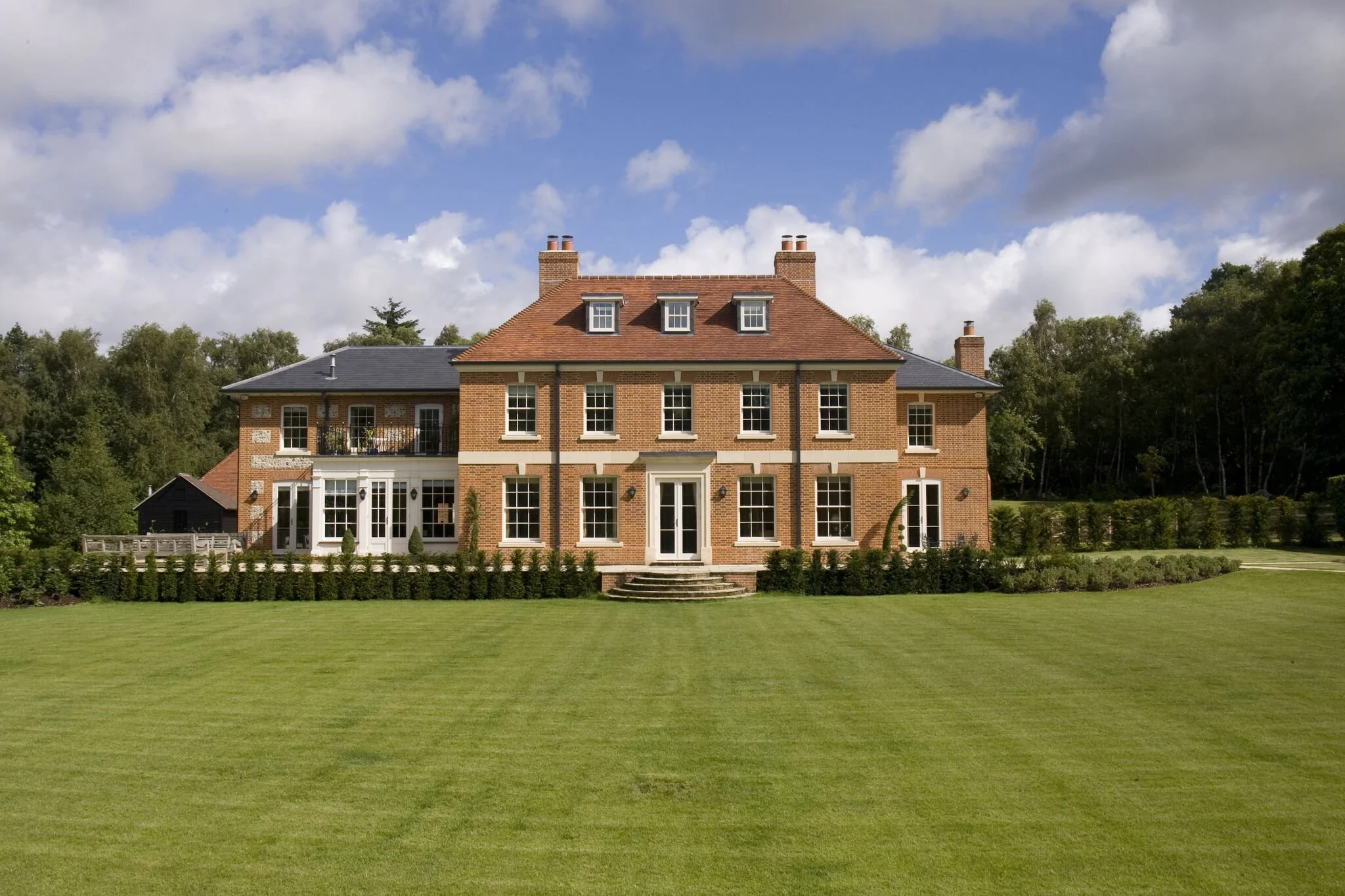
From an Understated Bungalow to a Classical Country House
Seeing the potential in sites can sometimes be difficult, an underwhelming house in the wrong place on the plot can cloud someone’s judgement. We relish the challenge of looking beyond the existing to create a dream property whilst is perfect for the site.
A good example of that is this project in Berkshire we designed which replaced an understated bungalow with a Classical country house. The resulting house is much more suited to the parkland like gardens and sylvan setting of the property.

A Drawing Room of a Grade Listed Georgian House
The drawing room of this Grade II listed Georgian house we have been working on the restoration of in Wiltshire is a very comfortable room. But the glow from the open grate makes it feel even cosier. The relaxed ambiance this creates is something we strive for in our work, a home that puts you at ease in comfortable and reassuring surroundings.

A Lattice Porch for a Regency Style Home
Elegance doesn’t have to mean grandeur.
We strongly believe that buildings can be elegant without having to be ostentatious. A home which looks relaxed will help the family living in it, feel relaxed. An example of how we employ this idea is this metal lattice porch on the front of a new build Regency style home we designed in Wiltshire. The entrance to this classic three bay form is clear and in keeping, without being overtly grand, making the whole building look more comfortable on the village lane on which it sits.

Retaining Character on a Barn Conversion
We really enjoy working on barn conversions.
Giving an historic building, now defunct, a new lease of life is a very fulfilling project. The key is not to lose the character. Here is a before and after image of a Grade II Listed barn we converted in Hampshire. The intention was to retain as much of the historic fabric and character of the barn as possible whilst converting the barn into usable residential space. Constructed by the talented team at Moulding The Builder, we think we were successful in retaining the essence of the original building whilst at the same time reinstating lost features such as the double height threshing door openings.
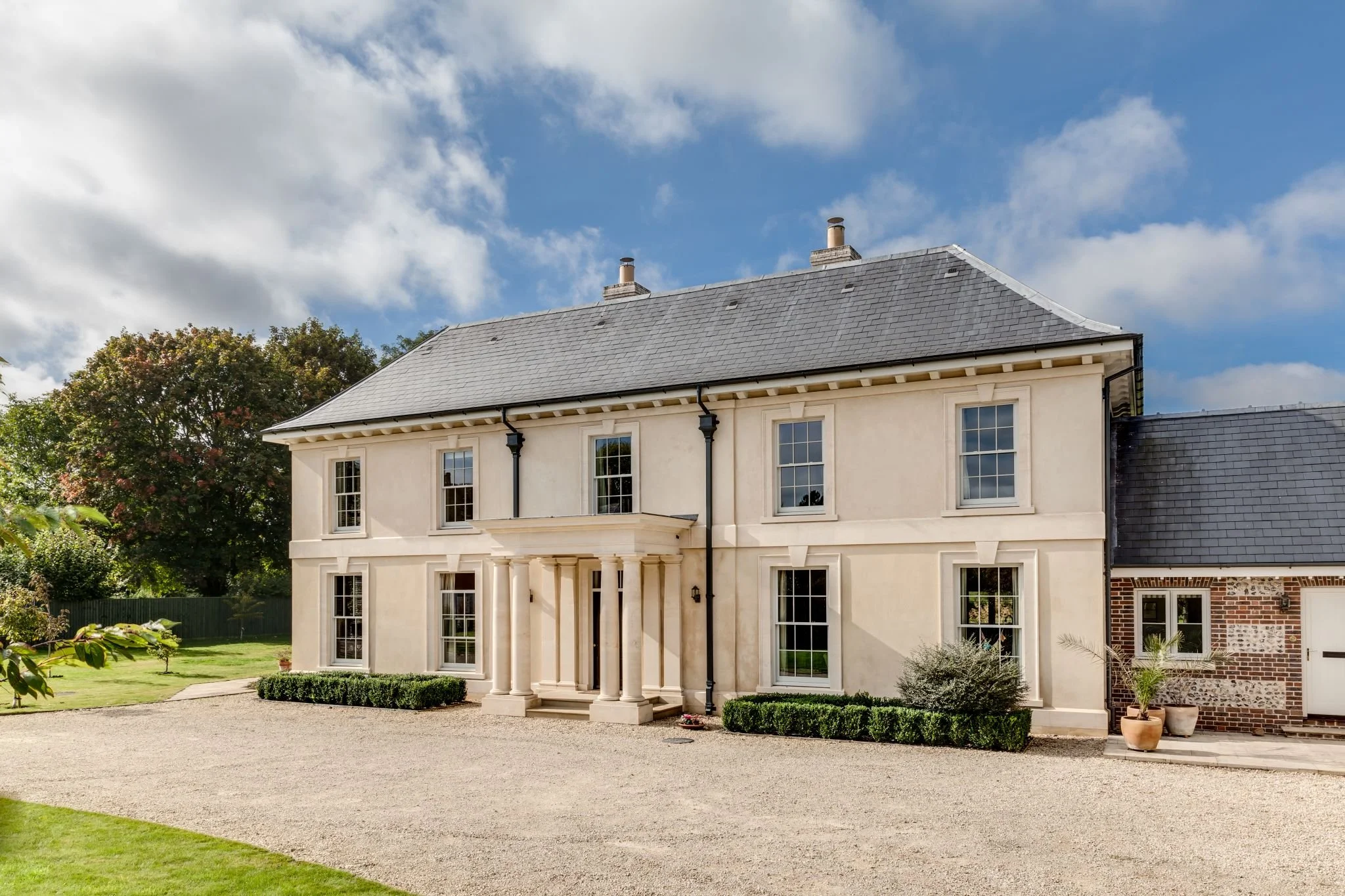
Design and Location
Context is key to a building feeling grounded in its location.
Although inspired by its surroundings, this award winning family home in Wiltshire does not borrow directly from its delightful Georgian neighbours. The design is instead the result of of the application of general principles of Georgian architecture. The outcome is a relaxed and pared-back design which is both comfortable as a modern family home should be, but with the elegance that comes with Classical architecture.

Introducing Renewable Technologies
It's good to be green, but being green shouldn't just be the preserve of new buildings, to really get on top of the problem, every building needs to be looked at carefully to see what can be done. If everybody does something, we'll be able to make a big difference. Even listed buildings can play their part.
We've recently gained planning and listed building consent for a program of restoration and upgrade works on a historic country estate in West Sussex. We have been working closely with Martin Thomas Associates M+E consultants, and a key part of the strategy worked out with them, is to introduce renewable technologies for the site. Here are some illustrations of the strategies to be utilised.

A New Country House in Hampshire
Sometimes the success of the new hinges on the past. We incorporate character into our new buildings by using materials specific to the local area, this allows them to sit more comfortably within their surroundings. In this case we used Chilmark stone from Lovell Stone Group, Michelmersh Brick Holdings PLC bricks and local flint.
This new country house in Hampshire was designed to appear as though it had evolved over time. The rear section was designed and details as a vernacular farmhouse, with the front section having a more formal Classical character, reflecting the evolution of many historic farmhouses, where their owners became more affluent and wished to enhance and gentrify their homes.

An Elegant Staircase Design
Another country house, another elegant staircase design.
For this project we designed this beautiful staircase which showcases traditional detailing at its best. The traditional wreathed volute at the end of the oak handrail compliments the single curtail of the bottom step and juxtaposes these traditional Georgian details with more contemporary metal spindles.

The Portico of an Elegant Grade II* Listed Town House
First impressions count. First impressions for a home, really count.
The portico of this elegant Grade II* listed town house was in need of some real tender loving care before we started our restoration project. The restored timberwork provides the sort of entrance you would expect and really sets the tone for the beautifully restored interior within.

The Importance of Proportion
We are passionate about proportion. Get it right and the elegance it creates is a given, you accept that things look right. Get it wrong and the fact something is amiss is obvious. The Golden Section (or Ratio) is a proportion system we often apply, using the mathematics of nature as described in the Fibonacci sequence, seen throughout nature and in Classical architecture. We used the Golden Section to get the proportions just so for this house in Wiltshire, and we were pleased when it won Best Traditional House in the Daily Telegraph Homebuilding and Renovating Awards The Telegraph.

A Historic Barn Conversion in Wiltshire
Even working on historic buildings, sometimes we get a chance to do something really striking, and we love to seize those opportunities!
This historic barn conversion in Wiltshire had views to the South over an Area of Outstanding Natural Beauty and we were able to secure consent for this feature dormer window. Not only did it allow views out, but it also allowed the previously uninhabited roofspace to be flooded with light, transforming the space from dingy loft to a light flooded and airy space.

Restoring a Georgian Townhouse
We feel that when working on listed buildings we have a responsibility to be sensitive to them and their history. Over restoring a building is often as bad as doing nothing at all.
This Georgian townhouse was in a very poor state of repair having been both a hotel and offices for many years. Lots of elements needed repairing, but we had to be careful to do it in such a way that the repairs were not obvious. The craftmanship in this field of Moulding The Builder is evident on this rubbed brick window head and key stone where they have executed our repair scheme in such a way that looking at it now, it simply looks ‘right’ rather than rebuilt.

Retaining Character
We consider ourselves very lucky to work on some beautiful barns. A key principle we adopt is to ensure that wherever possible the building keeps its character and still retains a barn like quality rather than that of a regular house.
Our scheme for this Grade II listed barn in Wiltshire carefully exposed the historic timbers in the former hay loft to ensure the buildings history could still be read. Careful placement of elements ensured we could incorporate the office and home cinema the brief required, without compromising the listed structure.

Reworking and Restoring Shopfronts
We don't only work in the country; our projects often take us into the town.
This project in a Conservation Area reworked a former car dealership in a pair of Grade II Listed buildings dating back to the late 1700s/early 1800s. The key move was to treat both buildings as separate, removing the unattractive and awkward 1970s single frontage and replacing with two new timber shopfronts more in keeping with the style of the individual buildings.

An Award Winning Country House Built on a Challenging Site
We love a challenge, whether that be a demanding brief, tricky topography or environmental restrictions. We find these challenges result in a solution which is robustly and intrinsically rooted in the place, making the building feel 'at home' in its surroundings from day one.
This award winning house in Wiltshire brought us a seriously challenging site in a UNESCO world heritage site and in an area of particular interest to the County Ecologist. The result is a comfortable home for a young family that feels like it's always been there, sitting comfortably in relation to the church, the conservation area and the rest of the village.

A Pool House Designed to Compliment a Tudor Gothic Revival Style Home
As it’s the first day of Summer we’ve been looking back at some photos of a pool house we designed at a country house in North Hampshire a few years ago.
The building was designed to compliment the Tudor Gothic Revival style of the main house and sits within a new landscape design by our talented client around the existing pool.

Transforming a Country House Built in 1908
Sometimes a client comes to us with an existing property which may look like it’s been altered too much to make something promising out of what’s there. Looking closely can sometimes give the germ of an idea for a rescue rather than a rebuild.
This 1908 country house in Wiltshire had been much modified over the years, but the striking gable of the original proved to be an excellent starting point for a triple gabled reworking as seen here in these before and after photos. Brickwork painted in a carefully selected shade, better proportioned timber sash windows and a reclaimed Welsh slate roof have completed the transformation.

Attention to Detail
How much detail is there in a staircase?
Quite lot as it happens. The staircase in this award winning home we designed in Wiltshire is the result of careful decisions over lots of details. A cut string. Scotia mouldings. Full height balustrade. Rotated spindles. Contrasting finishes between riser, tread and string. All these decisions and more come together to create the design we were looking to build, the trick is to make it look obvious and therefore simple…

Creating Access to a Wine Cellar
Old buildings often throw up unexpected challenges… For example, how to access the wine cellar of the Grade II* listed Georgian townhouse without compromising the original plan form of the room it is accessed from.
The solution was perhaps more Thunderbirds than George III, but installing a gib door and floor hatch minimise the visual intrusion and negate the need to bisect the space with an alien staircase. Sometimes our conservation work can challenge us, but the opportunity to work out neat solutions like these is why we relish that challenge.