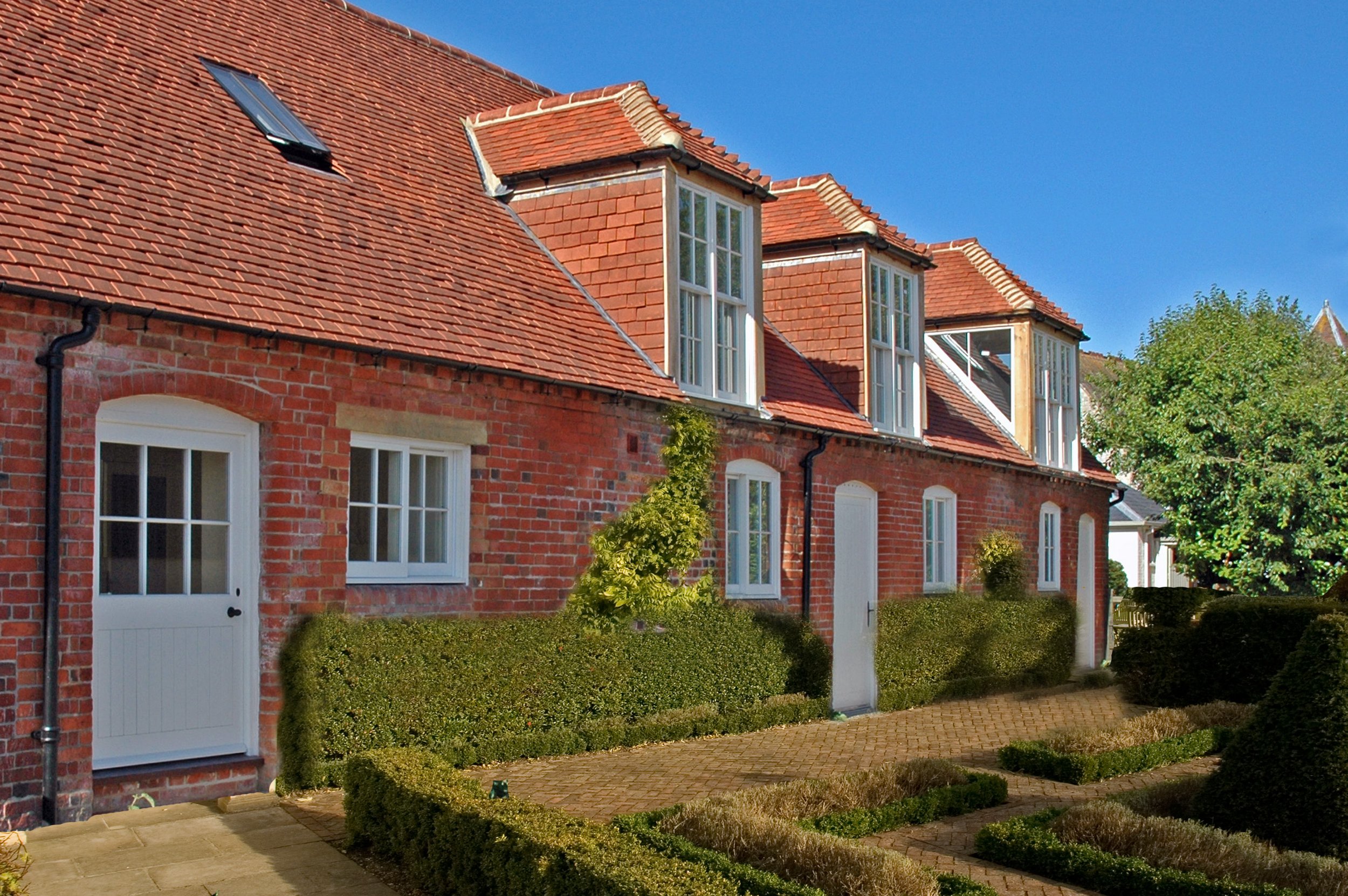
Grade II Barn Conversion in Wiltshire


A Sensitive Grade II Barn Conversion
This Grade II listed farmhouse and barn, dating from the late eighteenth to early nineteenth century, required a sensitive upgrade to support ancillary uses associated with the main house. The brief was to create a comfortable, contemporary environment while preserving the barn’s robust agricultural character and historic significance.
Constructed in chalkstone and flint on sarsen sill walls, with brick quoins to the gable end, the barn is distinguished by its tiled roof and quarter-hipped form facing the road. Internally, the space is divided into three bays by two arch-braced tie-beam trusses with collars, with a high-level queen-post truss marking the centre of the middle bay. These original elements establish the building’s strong spatial identity and formed the basis of the design approach.
To increase the flexibility of the interior while maintaining a clear sense of the barn’s full volume, two small mezzanine structures were introduced at either end of the building. These insertions were designed as wholly independent, self-supporting elements, ensuring that no additional load was imposed on the historic fabric.
The environmental upgrade focused on improving thermal performance without compromising character. Roof insulation was added above the existing timber rafters, allowing the original roof structure to remain visible internally, and the roof was re-tiled using the existing tiles. A new limecrete floor was also introduced, providing a solid, breathable surface while enabling LECA insulation to be installed beneath the slab. Given the solid wall construction and the presence of surrounding chalkstone, the limecrete floor was an appropriate solution, working in harmony with the building’s traditional materials and construction.
Relevant Projects